·
How to Write a Follow-Up Email After No Response (With Examples) | TextToools
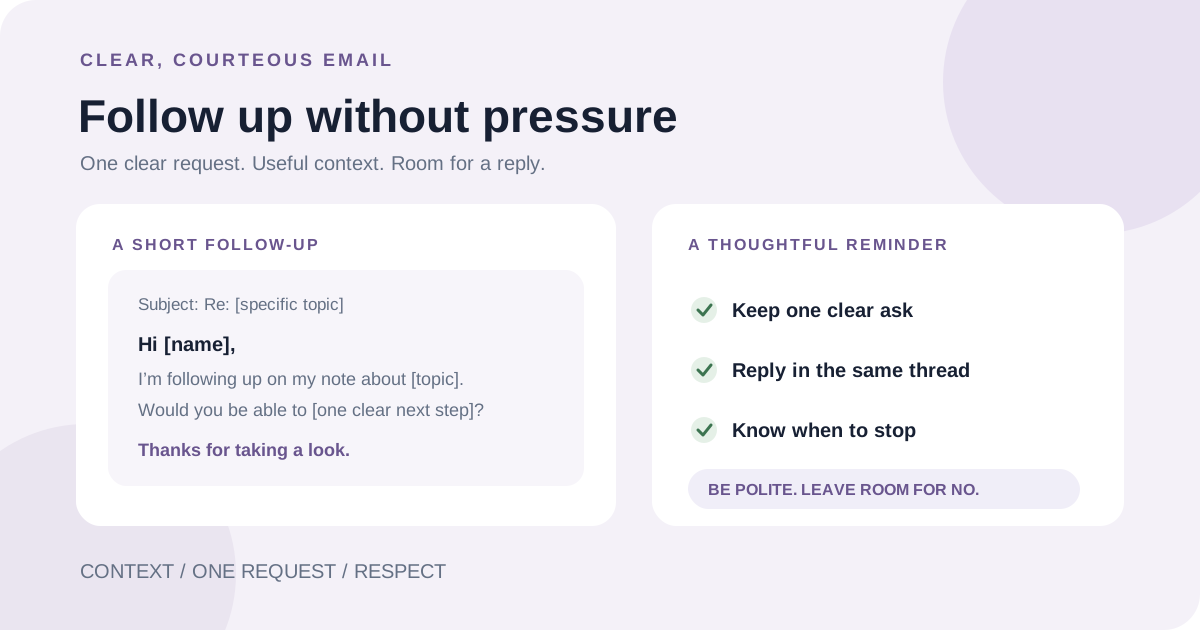
A good follow-up makes it easy to understand your earlier request and respond, without adding pressure or sending repeated reminders.
When a follow-up email makes sense
A follow-up can help when someone may have missed a message or needs a reminder about a reasonable request. It is not a guarantee of a reply, and silence can also mean the person is busy, unavailable, or not the right contact.
Consider the urgency, the recipient's workload, and any timeline they already gave you. A routine question may deserve more time than a decision holding up other work. There is no single waiting period that fits every situation; if a deadline is approaching, explain it calmly rather than sending several nudges in quick succession.
Keep the original context
When you are continuing the same conversation, reply in the existing email thread so the earlier message is easy to find. Use a specific subject that still describes the request. If the topic has changed, start a new message with a new subject instead of attaching unrelated questions to an old thread.
If the recipient may not remember you, add a short reminder of who you are and when you first wrote. Include only the context they need to understand the request; do not make them search through a long history to find the point.
Make one clear, easy-to-answer request
State why you are writing in the first sentence, then ask for one concrete next step. A focused question, a specific document to review, or a proposed time to talk is easier to answer than “just checking in” without saying what you need.
If timing matters, give the real date and a brief reason. Make it clear whether the date is a firm deadline or simply helpful. Do not invent urgency, bundle several unrelated requests together, or assume the recipient has already agreed to take action.
Use a polite, concise tone
Keep the reminder brief, courteous, and neutral. Assume the first message may have been overlooked rather than accusing the recipient of ignoring you. Thank them for their time, but avoid language that makes them feel guilty or pressured.
Before sending, remove repeated background, unnecessary apologies, and phrases that sound irritated. If you feel frustrated, pause and reread the message from the other person's perspective before deciding whether email is still the right channel.
Follow-up email examples
Adapt these examples to your relationship and the actual request. Replace each bracketed detail and only include a deadline or commitment that is real.
Choose the right timing and channel
Use the response time the recipient gave you if they provided one. Otherwise, allow a reasonable interval for the context and urgency; professional advice varies, so treat suggested waiting periods as guidance rather than a universal rule.
If the matter is genuinely urgent, a call, agreed work channel, or designated support route may be more appropriate than another email. Use the channel the person or organization has asked you to use, and do not send the same reminder through several channels at once.
Know when to stop following up
If a polite reminder and a further reasonable attempt receive no answer, repeated messages are unlikely to help. Reconsider whether the request is clear and proportionate, whether someone else is the correct contact, or whether you should proceed without a response.
A lack of response is not permission to escalate through unrelated channels or copy extra people to create pressure. For important work, follow the agreed escalation process; otherwise, leave the conversation open and move on.
A note from the founder
I prefer a follow-up that makes one small next step clear and leaves room for the other person to say no or suggest a better route. It is more respectful—and usually more useful—than sending another message that only says “checking in.”
About the author
Written by the founder of TextToools. I build straightforward browser tools for everyday writing and planning tasks.
Sources and further reading
- The Superpower of the Follow-up Email — Council for Advancement and Support of Education (CASE)
- E-mail Guidelines for Students — Writing Commons